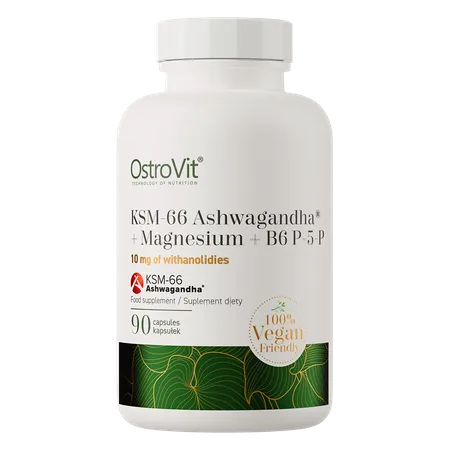
Short answer: which ashwagandha to choose?
For most people, a good place to start is with a standardized root extract (such as KSM-66 or a similar extract containing withanols) , rather than a “random” cheap powder with no stated active ingredient. Ashwagandha is an adaptogen used primarily for stress and sleep support; it is not a replacement for medication or a “testosterone miracle cure.”
- Stress/Balance: Standardized extract, consistent daily dose.
- Sleep: Evening consumption is suitable for many (personal tolerance).
- What to look for on the label: extract %, withanolides, recommended dosage, additives.
See the herbal extracts category (Omegafit). Not medical advice; pregnancy, thyroid and drug interactions — ask a specialist.
In stock now: Plant extracts
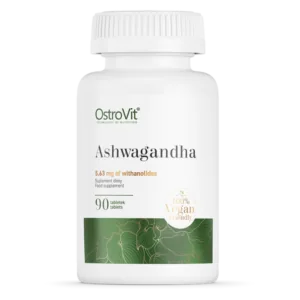
Ashwagandha – OstroVit
Plant extracts 9,90 € Select options This product has multiple variants. The options may be chosen on the product page
Ashwagandha (Withania somnifera) is an ancient Ayurvedic herb known as "Indian ginseng" — it is an adaptogen that helps the body better tolerate stress, improves sleep, supports testosterone and cortisol levels, and increases energy. Thanks to KSM-66 and Sensoril standardized extracts, ashwagandha has been one of the most researched herbal supplements of the last decade. In this guide, we explain how ashwagandha works, what the optimal dosage is, which form of KSM-66 to choose, and how to combine it with other supplements.
Last updated: September 2026

What is ashwagandha and how does it work?
Ashwagandha is an adaptogen — meaning it helps the body adapt to physical and mental stress. Unlike stimulants (e.g. caffeine), ashwagandha does not increase heart rate or cause anxiety — on the contrary, it normalizes levels of the stress hormone cortisol. The mechanism of action is based primarily on two components:
- Withanolides — active steroid lactones from ashwagandha roots that bind to GABA receptors in the brain (calming effect) and modulate the HPA axis (hypothalamic-pituitary-adrenal)
- Glycowithanolides — compounds with antioxidant properties that protect neurons and reduce inflammation
Clinical studies show that 8–12 weeks of consistent ashwagandha consumption (300–600 mg of KSM-66 extract per day) can lower cortisol levels by 27–32%, improve sleep quality, and increase testosterone by an average of 14–18% in men.
Ashwagandha Uses
Ashwagandha is rarely versatile — the same plant supports both mental and physical health at different stages of life:
Stress and cortisol reduction
The best-documented use of ashwagandha is for stress relief. A 2019 randomized, double-blind study (Salve et al.) found that 240 mg of ashwagandha per day reduced participants’ stress levels by ~32% (Perceived Stress Scale) and morning cortisol levels by an average of 27% over 60 days. Unlike SSRI antidepressants or tranquilizers, ashwagandha does not induce a numbing feeling of calm — the body simply responds to stressors in a more balanced way.
Sleep and sleep quality
Lower cortisol in the evening → faster falling asleep and deeper sleep. Studies show that 600 mg of ashwagandha for 6 weeks improves:
- Falling asleep faster (on average 14 minutes faster)
- Overall sleep quality (-20% on PSQI scale)
- Length of deep sleep (delta wave) phase
- Energy levels the next morning
The combination of ashwagandha with magnesium is particularly effective — magnesium relaxes muscles, ashwagandha calms the nervous system.
Testosterone and men's health
One of the most exciting benefits of ashwagandha for men is its ability to naturally increase testosterone levels. A 2019 study (Lopresti et al.) found that 600 mg of KSM-66 ashwagandha for 8 weeks increased testosterone levels by an average of 14.7% and DHEA-S levels by 18% in men aged 25–55. The men also experienced:
- Improved libido and sexual health
- Increased muscle mass (combined with exercise)
- Decreased body fat percentage
- Better sperm quality (motility, concentration)
Sports and physical performance
Athletes use ashwagandha for two reasons: faster recovery and improved exercise performance. A 2015 study (Wankhede et al.) found that 600 mg of KSM-66 ashwagandha for 8 weeks increased VO2max by ~14%, increased 1RM bench-press strength by 46%, and reduced post-exercise muscle damage (creatine kinase levels). The combination with creatine is a popular choice among endurance athletes and strength trainers alike.
Mental performance and concentration
Ashwagandha’s effects on the brain are long-lasting (not immediate like caffeine). Studies show that 8 weeks of regular consumption improves working memory, reaction time, and overall cognitive performance — especially in people under stress. This makes ashwagandha a good choice for students, business leaders, and anyone whose work requires prolonged concentration.
Women's hormonal balance
In women, ashwagandha supports thyroid function (especially in mild hypothyroidism), relieves PMS symptoms, and may help with postmenopausal fatigue. A 2018 study (Sharma et al.) showed that 600 mg of ashwagandha for 8 weeks improved T3 and T4 levels in patients with subclinical hypothyroidism.
Ashwagandha Dosage
The correct dosage depends on the intended use and the type of extract. KSM-66 and Sensoril (standardized extracts) require a lower dosage than regular root powder.
| Purpose | KSM-66 / Sensor dose | Common root powder | When to take |
|---|---|---|---|
| General stress, general health | 300 mg per day | 1000–1500 mg per day | In the morning or in two parts |
| Sleep, anxiety | 300–600 mg in the evening | 1500–2000 mg in the evening | 1–2 hours before sleep |
| Testosterone, sports | 600 mg per day | 2000 mg per day | In the morning + before training |
| Muscle mass, strength | 600 mg per day | 2000–3000 mg per day | On training days + rest day |
| Thyroid support | 600 mg per day | 1500–2000 mg per day | In the morning |
Important recommendations:
- Effects take time — ashwagandha is not immediate. Give it at least 4-8 weeks before evaluating results
- With food — avoid stomach upset, especially on an empty stomach
- Cyclicality — some experts recommend 8–12 weeks of use, then a 2–4 week break (so that the body does not get used to it)
- Morning vs. evening — if you're using it for stress/testosterone, take it in the morning. For sleep, take it in the evening.
KSM-66 and Sensoril are patented standardized extracts that contain a certain percentage of withanolides (KSM-66 contains ≥5% withanolides, Sensoril ≥10%). The dosage of such extracts is significantly lower than in conventional root powder, because the active ingredients are concentrated. OstroVit KSM-66 Ashwagandha 120 tablets is a good choice, because it contains the KSM-66 extract.
Ashwagandha forms — KSM-66, Sensoril vs. regular extract
There are several different forms of Ashwagandha on the market. Choosing the right one is of great importance for its effectiveness:
| Form | % of withanolides | Typical dosage | Advantages | Disadvantages |
|---|---|---|---|---|
| KSM-66 | ≥5% | 300–600 mg | Most researched, whole root (full-spectrum), water-extraction | A little more expensive |
| On the sensor | ≥10% | 125–250 mg | Highest concentration of withanolides, root+leaves | Some find it too sedating |
| Standardized (1.5–2.5%) | 1.5–2.5% | 500–1000 mg | Cheaper, good for beginners | Less active ingredient per dose |
| Common root powder | ~0.3% | 1500–3000 mg | The cheapest, traditional form of Ayurveda | Large quantity required, bitter taste |
Recommendation: For most people, KSM-66 is the best choice — enough active ingredient, but milder than Sensoril. For beginners , ICONFIT Ashwagandha 90 capsules (Estonian brand, 600 mg root powder equivalent per capsule) is a good choice. For athletes or experienced users , OstroVit KSM-66 Ashwagandha 120 tablets .
Side effects and precautions
Ashwagandha is generally a very well-tolerated herb — studies show that 8 weeks of 600 mg KSM-66 resulted in side effects in <2% of participants. However, some situations warrant caution:
Possible mild side effects
- Mild gastrointestinal discomfort — nausea, flatulence (especially on an empty stomach). Solution: take with food
- Daytime drowsiness — especially with higher doses. Solution: take dose in the evening
- Mild mood depression — rare, in some users. Transient
Who should avoid ashwagandha?
- Pregnant and nursing mothers — not enough research, may theoretically affect hormones
- People with hyperthyroidism (overactive thyroid) — ashwagandha increases T3/T4 levels, which may worsen symptoms
- Patients with autoimmune diseases (lupus, RA, MS) — may stimulate the immune system
- Those taking thyroid hormone medication — consult your doctor, dosage adjustment may be necessary
- People awaiting surgery — discontinue use at least 2 weeks before (sedative effect with anesthesia)
Our recommendation: the best ashwagandha products
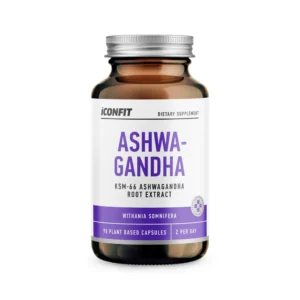
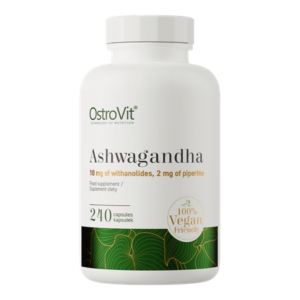
Ashwagandha and other supplements — the best combinations
Ashwagandha works particularly well with the following supplements:
- Magnesium — synergistic effect on sleep and stress. Magnesium relaxes muscles, ashwagandha calms the nervous system
- B vitamins (especially B6) — necessary for the production of serotonin and GABA, which ashwagandha supports
- Vitamin D — Vitamin D regulates testosterone production, while ashwagandha increases it. A combination especially powerful for men
- Creatine — for athletes, synergistic effect on muscle strength and recovery
- 5-HTP — to improve sleep (ashwagandha lowers cortisol, 5-HTP raises serotonin → melatonin)
- Omega-3 — reduces inflammation, which in turn supports the normalization of cortisol
Frequently asked questions
Does ashwagandha really increase testosterone?
Yes, but only in men and on average by 14-18% (not 50% as some ads promise). The effect is strongest in men with low-to-average testosterone. In healthy young men whose T levels are already high, the effect may be less. In women, ashwagandha does not significantly affect testosterone — there are separate female hormone complexes for that.
When does the effect of ashwagandha begin to manifest?
Unlike caffeine or 5-HTP, ashwagandha doesn’t have an immediate effect. The first changes (better sleep, feeling calmer) can appear within 1-2 weeks. The full effect (lower cortisol, higher testosterone, increased energy) usually occurs in 4-8 weeks. Give it time and track changes in a sleep diary or stress level diary.
Is ashwagandha addictive?
No, ashwagandha is not addictive or has any withdrawal symptoms. It is a natural adaptogen that can be taken for longer periods. However, some experts recommend cycling (8-12 weeks on + 2-4 weeks off) to prevent the body from getting used to it and maintaining sensitivity. However, long-term studies (up to 12 months) have not shown tolerance.
KSM-66 vs Sensoril — which is better?
Depends on the goal. KSM-66 (whole root, ≥5% withanolides) is better suited for daytime use — energy, testo, sports. Sensoril (root+leaf, ≥10% withanolides) is stronger and more sedating — better suited for evening and sleep. KSM-66 is also the most scientifically studied form (40+ clinical studies). For most users, we recommend KSM-66.
Is ashwagandha suitable for women?
Yes, very well. In women, ashwagandha supports cortisol reduction (relief of PMS symptoms), thyroid function, and sleep quality. A typical dosage for women is 300–600 mg of KSM-66 per day. Exceptions: pregnancy, breastfeeding, and hyperthyroidism.
Is ashwagandha suitable for athletes?
Yes, very well. Studies show a ~14% increase in VO2max, up to 46% strength gain (in 8 weeks), and faster recovery. For athletes, we recommend 600 mg of KSM-66 per day — half in the morning, half before training. The combination with creatine is the most popular choice for strength training.
Where to buy ashwagandha?
The Omegafit store has a wide selection — see the full range in Plant extracts. Popular in-stock options: Ashwagandha – OstroVit and Full spectrum ashwagandha 450 mg. We deliver to Estonia (1–2 business days), Latvia (2–3), Lithuania (2–4) and Finland (3–5); shipping is free over €49. You can also pick your order up in person at OG Gym, Roheline tn 74, Pärnu, Estonia.
Questions? Call +372 5562 2534 or write info@omegafit.ee.